

Behind the Badge – The Leyland ‘Plughole’
For generations of motor enthusiasts, the Leyland “L” logo has been affectionately known as the Leyland Plughole.
The nickname comes from its distinctive circular design, which bears an obvious resemblance to a household sink plughole. While graphic designers may identify the symbol as a form of swastika-inspired rotational motif, within the automotive world it has almost universally been referred to simply as the “Plughole”.
The logo first appeared in 1964, although not initially on vehicles themselves. Instead, it was introduced across company literature, parts packaging and official publications associated with Leyland’s growing portfolio of commercial vehicle brands, including AEC, Albion, Scammell and Guy. It also appeared on Triumph publications and genuine spare parts packaging, becoming a mark of factory-approved components.
By 1967, the Plughole was beginning to move from paperwork onto vehicles. Leyland commercial vehicles adopted the emblem, as did Triumph cars. Following Leyland’s acquisition of Rover in the same year, Rover vehicles also began displaying the badge. During this period, the design evolved, with some versions featuring the circular symbol enclosed within a square frame carrying the Leyland name beneath.
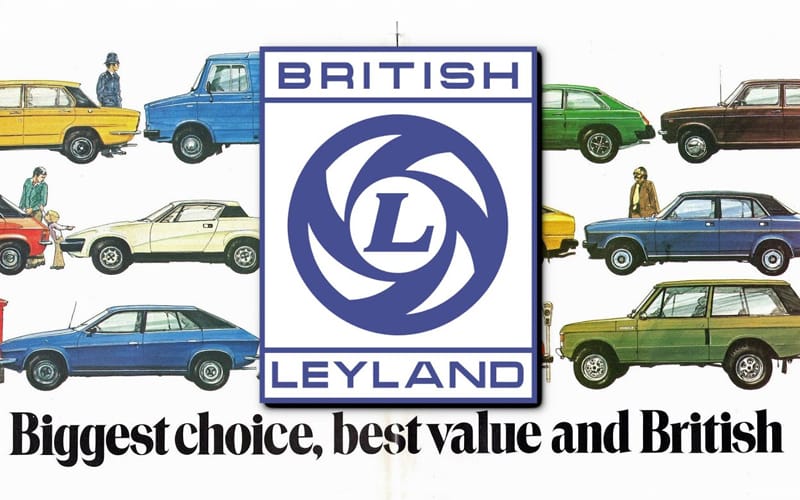
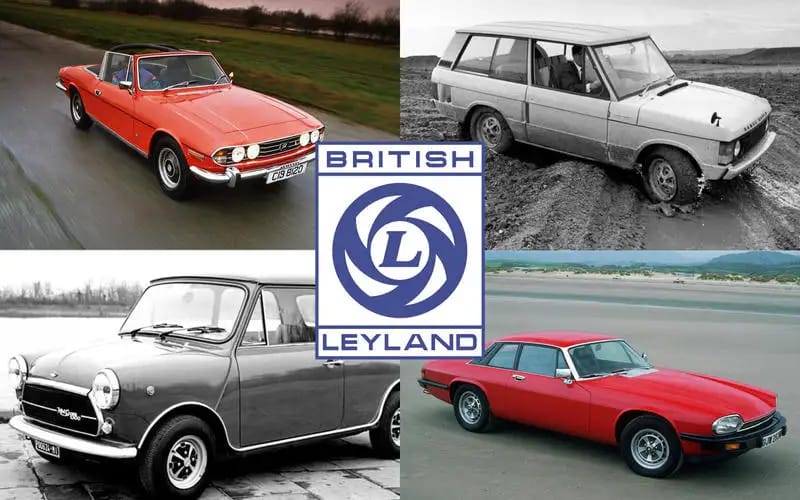
The logo became even more significant in 1968 with the formation of British Leyland Motor Corporation. Following the merger of British Motor Holdings and Leyland Motor Corporation, the badge was revised again. The familiar circular motif was now surrounded by a box featuring the word “British” above and “Leyland” below. This version appeared across an enormous range of products, from family cars and commercial vehicles to brochures, workshop manuals and genuine parts packaging.
Throughout the 1970s, the Plughole became one of the most recognisable symbols of the British Leyland era. Whether attached to a Rover saloon, a Triumph sports car, a Leyland truck or a dealership parts counter, it represented one of Britain’s largest vehicle manufacturing groups that employed hundreds of thousands of people in 92 factories in the UK alone and produced vehicles for markets around the world.
A change was coming
However, change was on the horizon. Following the restructuring of British Leyland in 1975, the boxed “British Leyland” version was phased out for cars, returning the emblem to its simpler circular form. This streamlined logo continued to appear on vehicle publications and parts packaging throughout the late 1970s.
By 1979, a new corporate identity emerged in the form of the Austin Rover logo, featuring coloured diagonal stripes within a rectangular shape. This gradually replaced the Plughole across passenger cars. The final Austin Morris models to carry the emblem included the Allegro, Maxi, Marina Ital, Ambassador and commercial Mini derivatives. Some vehicles even displayed both Austin Rover and Plughole branding during the transition period.
The Plughole is still present today
Although the badge disappeared from cars by 1984, its story did not end there. The logo continued to appear on commercial vehicles until around 1987 and remained in use on Leyland buses until the Leyland name itself was finally phased out by Volvo in the early 1990s. Still the logo refused to die – the Indian former outpost of British Leyland, Ashok Leyland, still uses the Plughole logo on its trucks and buses right up to the present day.
Today, the Leyland Plughole remains a powerful symbol of Britain’s automotive heritage. To enthusiasts, it represents far more than a simple logo. It is a reminder of an era when many of Britain’s most famous vehicle manufacturers sat under one corporate banner and when a single badge united everything from sports cars and luxury saloons to trucks, buses and military vehicles.
Back To News